Four ways to keep kindergarten ESL students focused all day

Heath Pulliam
A teacher sat in a classroom with a child, sharing crayons with eachother and smiling
Reading time: 5 minutes

Heath Pulliam is an independent education writer with a focus on the language learning space. He’s taught English in South Korea and various subjects in the United States to a variety of ages. He’s also a language learning enthusiast and studies Spanish in his free time.

Those who have taught children anywhere between the ages of 4 and 8 know that one of the biggest challenges of getting through to them is keeping your presentation style interesting. As someone who taught ESL in South Korea to kindergarteners, there are a few factors that make keeping students engaged a challenge. In countries where students learn English, students often have a heavy courseload and high expectations. As a first-year teacher, I learned a lot about what worked and what didn’t through trial and error. These are four methods that I consistently used to keep my students interested and engaged all day.

Students are quick to lose focus at such a young age. You’re not speaking their mother tongue and some parts of an ESL curriculum are less than exciting. With young students, you can’t lecture your way through the material all day. Kindergarteners have a small window of focus and it must be capitalized on. The following methods are ones that worked for me and can be modified to cover any topic you’ll run into in an ESL curriculum.

Activities to engage pre-primary ESL students all day
Reproducir
Privacy and cookies

By watching, you agree app can share your viewership data for marketing and analytics for one year, revocable by deleting your cookies.

1.The wheel of names

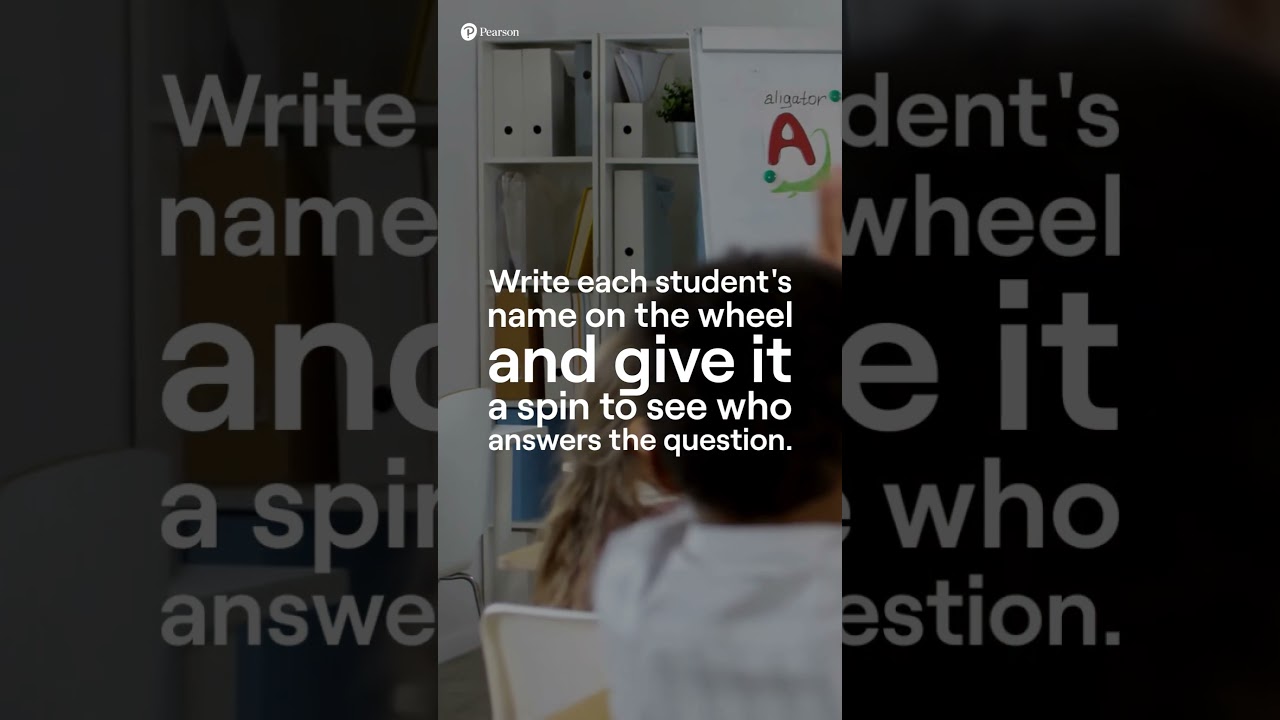
Don't let the simplicity of this tool fool you. The Wheel of Names, which is exactly what it sounds like, is a very simple tool that you can put the names of your students on to randomly (or not) select a student. The Wheel of Names crushes hand-raising and it’s a constant struggle to get everyone raising their hands. (We can’t let the quiet ones just slip through the cracks!)

The beauty of the Wheel of Names is the guaranteed excitement on every spin. They’re kindergarteners. The nature of randomizing who’s going to answer the question, come up to the board, or go first in a game is so exciting to them. Use it however you want. The suspense has kids excited to see who will be chosen and has them cheering on whichever classmate gets chosen.

I used this tool mostly during review sessions to choose students to answer questions. It can also be used for creating small groups, making sure everyone gets a chance to speak during activities and seeing who’s going to get to do the next fun thing in the classroom. You’re teaching kindy, have fun with it.

2.Team-based review game

We never came up with a good name for this game, but we used it a lot. Every Friday, during our chapter review, this was undoubtedly the best compromise between fun and effectiveness for reviewing material. It also fosters speaking, one of the most important parts of learning a language.

Here’s how it works. The class is separated into two teams. (For a little extra fun, use the wheel of names or a cup of popsicle sticks with students’ names on them to select the teams.) The teacher has a set of review questions or vocabulary words. On each turn, one person from each team has a chance to answer the question. You can do hand-raising or a randomization method to pick who answers.

If the student representative from the team gets it right, they earn a point. If they get it wrong, the opposing team gets a chance to answer for a point. Alternating between each team, the first to a certain number of points wins. A simple game, but at this age many students are just getting used to team-based activities.

This game is so effective because it makes use of children’s natural competitive spirit. When one student is up, the rest of their team cheers them on. Learning material is important, but a big part of teaching young students is teaching them social skills, too. This game gets everyone excited and gets the material to stick. It also teaches them the importance of teamwork and how to win and lose gracefully. (Not everyone can win every time).

3.Creating super sentences

At the end of the year, the students in my class ended up being the best writers in their respective age groups. I think this activity, making ‘Super Sentences” a few times a week was a big contributor to that. Inspired by a textbook we had, here’s how this activity works.

We’d create sentences with this formula:

Who or what – The owl

Did what – hunted for mice

Where – in the forest

When – at night

The owl hunted for mice in the forest at night.

Before students got to work on their own, We’d fill out a little table on the board as a class that looked something like this – but changed every time.

Who or what?

(noun)

Did what? (verb)

Where?

(prepositional phrase)

When?

(prepositional phrase)

The dog

The raccoon

Joey

Mr. Heath

Chloe

The thief

Ran

Slept

Attacked _______

Found _________

Learned to ________

sneaked

On top of __________

Under __________

Through the ________

Next to the ________

Inside of the _______

Behind the ________

At sunset

At 4:00 PM

In the middle of the day

In March

In the evening

After this, students can get to work making their own sentences and drawing what is happening below. After a few times, many students began to make up their own nouns, verbs and prepositions that were not listed on the board. And when everyone gets comfortable writing sentences, you can add a ‘Why?’ section at the end.

This activity is one of my favorites because it helps bring out children’s natural creativity. In an ESL curriculum, there’s a lot of material that’s less than exciting, so any way to give the kids a little freedom can be a game-changer. It’s also great for vocabulary, grammar and writing practice.

To finish off the activity, have each student read their sentence and have the class vote on their favorite for a prize!

4. Vocabulary bingo

Something to know about teaching ESL in non-English-speaking countries is that often, no time is allowed to be spent not learning. This is definitely the case in South Korea. Even after lunch and towards the end of the day, students are rarely allowed to do anything if it isn’t enriching. Because of this, playing games that are fun and learning-effective is a must.

Now, I’m certainly not the first one to play Bingo. This version however, is slightly modified to be as enriching as possible. We played this version often at the end of the day, because focus runs low around that time.

Essentially, this is just vocabulary bingo with a little bit of charades mixed in. For this activity, make a basic bingo board with some of your current vocabulary words or target language. There are plenty of sites that make this easy.

What makes this version different is that on each turn, rather than telling everyone the word, describe it to the class and try to get them to guess what the word is. So, if the word was ‘teamwork’, you might say something like “This is what it’s called when everyone works together to help their team win.” You can even have a student helper that helps facilitate the game by giving the descriptions.

After the word is guessed, reiterate it to the class and proceed with Bingo as usual.

Conclusion

Part of being an effective teacher, especially with the younger ages, is harnessing kids’ natural excitement, energy and innate curiosity to their own benefit. Instead of suppressing it, it’s essential to adapt your teaching style to work for your students.

Teaching ESL to young children has its own set of challenges. They can hardly sit still for an hour of lecture, let alone a whole day. Make use of, or draw inspiration from these methods and see how they can work for you.

Teaching young learners? Read our post'Effective classroom management routines for very young learners'.

More blogs from app

  • Children stood around a laptop with a teacher smiling
    Educator wrapped 2025
    Por
    Reading time: 4 minutes

    If 2025 taught us anything, it’s that educators who lead with heart, ingenuity and resilience help students thrive. Your creativity drove the momentum. Your learners set the direction. Our role at app was to support your journey with tools that save time, create impact and open more opportunities for your students.

    Here’s your Educator Wrapped for 2025.

  • University students sat in a lecture hall, one has his hand raised
    Supporting student success beyond admissions
    Por
    Reading time: 2 minutes

    In international education, admissions are just the beginning. While securing a place at a university is a massive milestone for a student, measuring success continues for them from the moment they arrive on campus. Institutions know that academic performance, engagement and retention are shaped long before the first lecture begins, and one of those critical factors is English languageproficiency.

    Students who begin their studies with the right level of English are better equipped toparticipatefully in academic life. They understand course material, contribute to discussions and complete assignments with confidence. This foundation does not support individualachievement;it also strengthens the entire learning environment.

    That is why reliableproficiencytesting is more than an admissions tool. It is a strategic investment in student success.

    The link between proficiency and performance

    Universities have long understood the connection between language readiness and academic outcomes. When students are placed correctly, they are more likely to thrive. Misplacement, on the other hand, can lead to frustration, disengagement and even dropout.

    Reliable testing helps institutions avoid such pitfalls. It ensures that students are matched to the right level of study, reducing the need for remedial support and improving retention rates. For universities, this translates into stronger performance metrics and a cohesive student experience overall.

    app English Express Test: A foundation for success

    The app English Express Test is designed to support this journey before day one. With fast,secureand trusted results, it gives both students and institutions the clarity they need to move forward with confidence.

    It delivers certified scores within 48 hours, allowing universities to maketimelydecisions and students to begin their academic journey without delay. It is AI-powered scoring and alignment with CEFR and GSE frameworks ensures accuracy, while remote proctoring and identityverficationprotect the integrity of the results.

    This combination of speed, precision and security makes the app English Express Test more than just a test but a strategic tool for long-term success

    Institutional value that goes beyond admissions

    For universities, adopting the app English Express Test is not just about streamlining admissions;itis about strengthening the entire student lifecycle. By ensuring that potential students are linguistically prepared, institutions can reduceacademic risk, improve retention and enhance their reputation for supporting international learners.

    The app English Express Test helps universities todemonstratea commitment to quality and care. It shows that they are not just admitting students, they are setting them up for success.

    A smarter start for international students

    In a competitive global education market, institutions need solutions that go beyond the basics. The app English Express Test offers a smarter, more strategically driven approach to language assessment. One that not only supports them getting into university, but also from application to graduation.

    By choosing the app English Express Test, universities are investing in outcomes thatmatter:academic success, student satisfaction and long-term institutional positive impact.

  • Youung adults outside dressed up warm chatting together
    Celebrating global holidays: Inclusive festive activities for your English classroom
    Por
    Reading time: 4 minutes

    Across classrooms, holidays show up as stories, songs, recipes, colors and customs. For English educators, they also offer language tasks that build communication, intercultural understanding and community. The key is to celebrate in a way that’s inclusive, academically rich, and respectful of diverse beliefs and backgrounds. Here are some activities you can do this festive season with minimal fluff and maximum impact, each tied to clear language objectives.

    Principles for inclusive festive learning

    • Student choice: Invite learners to showcase their traditions, for example, Diwali, Lunar New Year, Eid, Hanukkah, Christmas, Día de los Muertos, Nowruz or a seasonal theme without a religious focus.
    • Language-first design: Anchor activities in explicit objectives – for example, “Can describe customs and traditions,” “Can compare events,” “Can write instructions” – to ensure measurable progress.
    • Do-no-harm approach: Provide opt-in alternatives, avoid stereotyping and create space for students who do not celebrate holidays.
    • Representation: Use materials that reflect multiple regions and voices. Encourage translanguaging to deepen understanding and honor identity.
    • Accessibility: Scaffold with visuals, sentence frames and leveled texts so every learner can contribute meaningfully.