Four ways to keep kindergarten ESL students focused all day

Heath Pulliam
A teacher sat in a classroom with a child, sharing crayons with eachother and smiling
Reading time: 5 minutes

Heath Pulliam is an independent education writer with a focus on the language learning space. He’s taught English in South Korea and various subjects in the United States to a variety of ages. He’s also a language learning enthusiast and studies Spanish in his free time.

Those who have taught children anywhere between the ages of 4 and 8 know that one of the biggest challenges of getting through to them is keeping your presentation style interesting. As someone who taught ESL in South Korea to kindergarteners, there are a few factors that make keeping students engaged a challenge. In countries where students learn English, students often have a heavy courseload and high expectations. As a first-year teacher, I learned a lot about what worked and what didn’t through trial and error. These are four methods that I consistently used to keep my students interested and engaged all day.

Students are quick to lose focus at such a young age. You’re not speaking their mother tongue and some parts of an ESL curriculum are less than exciting. With young students, you can’t lecture your way through the material all day. Kindergarteners have a small window of focus and it must be capitalized on. The following methods are ones that worked for me and can be modified to cover any topic you’ll run into in an ESL curriculum.

Activities to engage pre-primary ESL students all day
Play
Privacy and cookies

By watching, you agree app can share your viewership data for marketing and analytics for one year, revocable by deleting your cookies.

1.The wheel of names

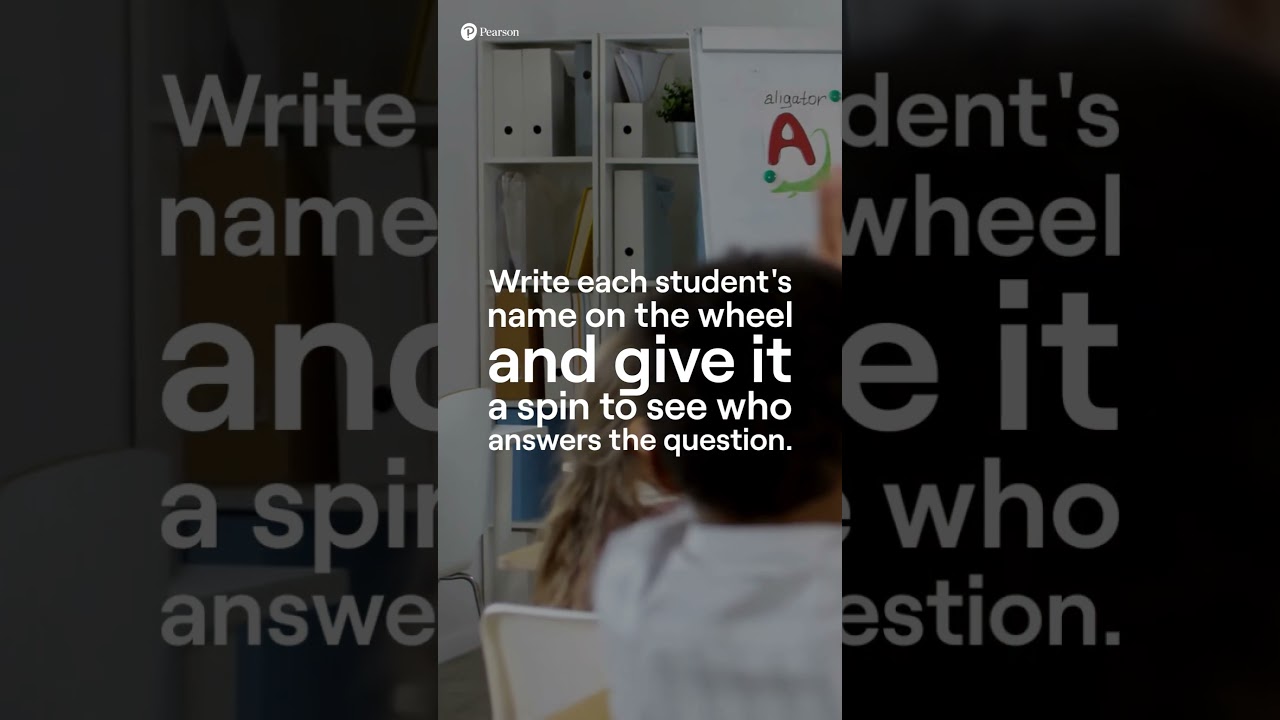
Don't let the simplicity of this tool fool you. The Wheel of Names, which is exactly what it sounds like, is a very simple tool that you can put the names of your students on to randomly (or not) select a student. The Wheel of Names crushes hand-raising and it’s a constant struggle to get everyone raising their hands. (We can’t let the quiet ones just slip through the cracks!)

The beauty of the Wheel of Names is the guaranteed excitement on every spin. They’re kindergarteners. The nature of randomizing who’s going to answer the question, come up to the board, or go first in a game is so exciting to them. Use it however you want. The suspense has kids excited to see who will be chosen and has them cheering on whichever classmate gets chosen.

I used this tool mostly during review sessions to choose students to answer questions. It can also be used for creating small groups, making sure everyone gets a chance to speak during activities and seeing who’s going to get to do the next fun thing in the classroom. You’re teaching kindy, have fun with it.

2.Team-based review game

We never came up with a good name for this game, but we used it a lot. Every Friday, during our chapter review, this was undoubtedly the best compromise between fun and effectiveness for reviewing material. It also fosters speaking, one of the most important parts of learning a language.

Here’s how it works. The class is separated into two teams. (For a little extra fun, use the wheel of names or a cup of popsicle sticks with students’ names on them to select the teams.) The teacher has a set of review questions or vocabulary words. On each turn, one person from each team has a chance to answer the question. You can do hand-raising or a randomization method to pick who answers.

If the student representative from the team gets it right, they earn a point. If they get it wrong, the opposing team gets a chance to answer for a point. Alternating between each team, the first to a certain number of points wins. A simple game, but at this age many students are just getting used to team-based activities.

This game is so effective because it makes use of children’s natural competitive spirit. When one student is up, the rest of their team cheers them on. Learning material is important, but a big part of teaching young students is teaching them social skills, too. This game gets everyone excited and gets the material to stick. It also teaches them the importance of teamwork and how to win and lose gracefully. (Not everyone can win every time).

3.Creating super sentences

At the end of the year, the students in my class ended up being the best writers in their respective age groups. I think this activity, making ‘Super Sentences” a few times a week was a big contributor to that. Inspired by a textbook we had, here’s how this activity works.

We’d create sentences with this formula:

Who or what – The owl

Did what – hunted for mice

Where – in the forest

When – at night

The owl hunted for mice in the forest at night.

Before students got to work on their own, We’d fill out a little table on the board as a class that looked something like this – but changed every time.

Who or what?

(noun)

Did what? (verb)

Where?

(prepositional phrase)

When?

(prepositional phrase)

The dog

The raccoon

Joey

Mr. Heath

Chloe

The thief

Ran

Slept

Attacked _______

Found _________

Learned to ________

sneaked

On top of __________

Under __________

Through the ________

Next to the ________

Inside of the _______

Behind the ________

At sunset

At 4:00 PM

In the middle of the day

In March

In the evening

After this, students can get to work making their own sentences and drawing what is happening below. After a few times, many students began to make up their own nouns, verbs and prepositions that were not listed on the board. And when everyone gets comfortable writing sentences, you can add a ‘Why?’ section at the end.

This activity is one of my favorites because it helps bring out children’s natural creativity. In an ESL curriculum, there’s a lot of material that’s less than exciting, so any way to give the kids a little freedom can be a game-changer. It’s also great for vocabulary, grammar and writing practice.

To finish off the activity, have each student read their sentence and have the class vote on their favorite for a prize!

4. Vocabulary bingo

Something to know about teaching ESL in non-English-speaking countries is that often, no time is allowed to be spent not learning. This is definitely the case in South Korea. Even after lunch and towards the end of the day, students are rarely allowed to do anything if it isn’t enriching. Because of this, playing games that are fun and learning-effective is a must.

Now, I’m certainly not the first one to play Bingo. This version however, is slightly modified to be as enriching as possible. We played this version often at the end of the day, because focus runs low around that time.

Essentially, this is just vocabulary bingo with a little bit of charades mixed in. For this activity, make a basic bingo board with some of your current vocabulary words or target language. There are plenty of sites that make this easy.

What makes this version different is that on each turn, rather than telling everyone the word, describe it to the class and try to get them to guess what the word is. So, if the word was ‘teamwork’, you might say something like “This is what it’s called when everyone works together to help their team win.” You can even have a student helper that helps facilitate the game by giving the descriptions.

After the word is guessed, reiterate it to the class and proceed with Bingo as usual.

Conclusion

Part of being an effective teacher, especially with the younger ages, is harnessing kids’ natural excitement, energy and innate curiosity to their own benefit. Instead of suppressing it, it’s essential to adapt your teaching style to work for your students.

Teaching ESL to young children has its own set of challenges. They can hardly sit still for an hour of lecture, let alone a whole day. Make use of, or draw inspiration from these methods and see how they can work for you.

More blogs from app

  • A child running with a rugby ball outside, with children behind them

    How can gaming support language learning?

    By Jacqueline Martin

    Reading time: 5 minutes

    Academics and teachers have been writing about the benefits of using games in the language classroom for many years. Wright et al (1984), Lee Su Kim (1995), Ubermann (1998), Ersoz (2000), Yong Mei and Yu-Jin (2000) and Thi Thanh Huyen and Khuat Thi Thu Nga (2003) all pretty much agreed that games provide a useful and meaningful context for language use; encourage students to interact and communicate; can both challenge and reduce anxiety (as the emphasis is on the message, not the form); provide practice in all four skills; and help students to make and sustain the significant effort involved in learning a language.

    Kim and others have also noted that games can offer a welcome break from the usual routine of the language class. Playing a game after an intensive test or with over-excited students after break time can help re-engage learners instantly in your lesson, and you'll maximize your time with them.

    Lengeling and Malarcher (1997) took the list of potential benefits of games in the classroom even further.

    Affective

    • Games lower the affective filter
    • They encourage the creative and spontaneous use of language
    • They promote communicative competence
    • Games are both motivating and fun

    Cognitive

    • Games reinforce learning
    • They both review and extend learning
    • Games focus on grammar in a communicative manner

    Class dynamics

    • Games are extremely student-centered
    • The teacher acts only as a facilitator
    • Games build class cohesion
    • They can foster whole-class participation
    • Games promote healthy competition

    Adaptability

    • Games can be easily adjusted for age, level and interests
    • They utilize all four skills
    • Games require minimum preparation after the initial development stage

    It is important to bear in mind that when the above was written over 20 years ago, it was with reference mostly to more traditional games. But more recent evidence seems to indicate that the same principles apply. Some additional benefits cited by teachers I've spoken to are that:

    • Games could make language lessons less threatening for less confident pupils as their concern about getting sentence form wrong was reduced, and so their production greater.
    • Students learn more than just the language of the lesson when playing a game; they may learn instructional language through discussion or rules and sometimes negotiation skills and a lesson in cultural differences too.
    • Students can form a greater variety of emotional connections with language through playing games, for example acting out a word or seeing another student do so, or remembering a clue for a word.

    So, playing games can help students learn a language – but is just playing them enough? Some teachers like using games with less motivated classes who won't engage with straight practice activities and will willingly use key vocabulary and structures in a game, gaining much-needed practice without even realizing it. In today's language-learning context, though, is that a good thing?

    Motivating the unmotivated

    In recent years, much research has shown that students learn better when the intention or objective of the lesson is clear to them. In short, they understand what they're supposed to be learning and why and, when taking it to the next level, can assess their own learning and be actively involved in planning their next steps.

    Would knowing that the games they play are actually a way of doing some additional language practice make these students engage less? Opinion differs, and some discussion seems to center around the actual activity involved. Some games are thinly veiled group-work tasks, but other games that are at the right proficiency level (or slightly above) and take into account factors like cultural context, available time, learning topic and the classroom setting are generally considered to have a positive impact.

    Another major influence on improving motivation is the feedback a student receives, and this is something games can also support. Online games can provide richer simulated learning experiences and immediate feedback to students in a variety of ways.

    Above all, the main issue for the less motivated students is usually that they can't see why they need to learn English. Playing games not only simulates 'real' contexts but also helps them understand that they can accomplish a variety of tasks using English as a medium, which is motivational in itself.

    As teachers, there is a responsibility to explain how or why games will help students learn. This can equally motivate learners (or parents) who fear that playing games is just frivolous time-wasting. For example, informing even adult students that a simple hangman or hot seat game helps them improve spelling skills, gets their brains focused on recognizing the shape and structure of new words, and facilitates their learning of new vocabulary soon helps them see the value (Simpson 2011).

    Can games help learners acquire 21st-century skills?

    Maybe we can draw the conclusion that games can positively impact learning – but is that even enough? Today's teachers have to ensure not just that their students learn but that they acquire the skills they need for life and jobs in the 21st century. Can games help here too? This is a newer area of research, but evidence seems to indicate that games can help students learn a variety of important skills such as critical thinking skills, creativity, teamwork and good sportsmanship.

    These ideas were taken seriously by Robert Morris University Illinois, who offered an e-sports scholarship for the first time in 2014. They studied two groups of students – football players and gamers – and found that levels of competitiveness, perseverance, focus and determination were very similar. Both groups showed a similar desire to excel as part of a team. Both 'sports' required the team members to be detail-orientated, have good hand-eye coordination and have a strategic mind. The only difference was in the level of cardiovascular activity. Both groups received performance analysis and tactical advice from coaches and both subsequently made improvements.

    How many universities will start to offer these types of programs remains to be seen. Still, the idea that online competitive gaming can improve performance is being brought to the workplace too. Think about what virtual teams could learn from playing role-based collaborative games. Team members have set roles and clear and shared goals and have to work closely together to formulate an action plan to achieve them. Teamwork, skill, strategic thinking and communication are essential.

    All these are important skills for today's workplace, so maybe gaming can provide an opportunity to hone these in a lower-risk environment and improve business performance.

    These examples are clearly far from the norm, but they do seem to indicate that using gaming to support learning in the classroom is not a waste of time. When you get the right mix of gaming and learning, it develops a student's autonomous learning skills and encourages them to spend more time on task – both of which greatly impact learner outcomes.

  • A woman smiling with a backpack stood outside in a cobbled square with many people in the background

    Language learning tips for international students

    Reading time: 4 minutes

    Are you studying abroad (or soon to be), learning a new language and need some inspiration on ways to practice your language skills in the real world? Don't worry. It can be daunting to know how to begin, especially in an unfamiliar place, However, with a little bit of effort and following these useful tips, you will be able to improve your language skills and make the most of your study abroad experience.

  • two colleagues working outdoors talking to eachother over a laptop and paperwork

    The role of English proficiency in a global organization

    By Samantha Ball
    Reading time: 4 minutes

    To compete in the modern business space, many organizations are shifting to a more global way of working.

    The COVID-19 pandemic accelerated digital transformation and globalization across industries but, as many businesses look now to sustaining future growth, the question is: what powers a successful, global organization?

    Why English proficiency is key to unlocking international success

    According to app’s 2022 Power Skills Survey, one of the biggest factors in effective workplace globalization is the use of English as a common language. The report states “Adopting a common language and ensuring that the entire workforce can access it has become more important than ever before.”

    It points to statistics from rising economies in Southeast Asia, showcasing the strength of English use and their respective booming industries:

    • In Indonesia, Southeast Asia’s largest economy in terms of GDP, the service sector employs nearly half of the country’s local workforce.
    • In Thailand, nearly 60% of the country’s GDP is generated by tourism and export-oriented production. Vietnam, one of APAC’s fastest-growing markets and a rising manufacturing powerhouse, counts the US among its top trading partners.
    • The Philippines’ business process outsourcing (BPO) sector, a key pillar of the country’s economy, employs 1.3 million people.

    The power of effective communication

    app’s 2022 Power Skills Survey is a drop in the ocean of reports hailing effective communication as one of the top factors to both personal and business success. Good communicators have been linked to higher performance in school, at work and in their personal lives. It is no surprise then that good communicators are highly sought after by talent recruiters.

    With many businesses moving to hiring outside of traditional location boundaries, more languages are inevitable in the workplace. So, can good communication transcend language barriers?

    As the statistics gathered by the Power Skills Survey show, there is evidence that sharing one common language, and therefore enabling more effective communication, can improve business opportunities, workforce growth and ultimately the economy. In the survey report, Norlida Azmi, Group Chief People Officer at Axiata, said:

    “Communication is a critical skill that sets the foundation for not only leadership competencies, such as people management and coalition building, but also for wider and effective stakeholder management in the ecosystem – communicating with our shareholders, customers and the communities that we operate in.”

    English: the official language of business

    While communication for globalization can look different for different markets, the English language is recognized as the prevailing choice for multinational companies. The Harvard Business Review says:

    “The need to tightly coordinate tasks and work with customers and partners worldwide has accelerated the move toward English as the official language of business.”

    So, with businesses now fighting to grow in a global marketplace, unlocking the power of the English language is crucial to success.

    Assessing English proficiency within your organization

    The survey shows that many organizations have work to do in this area, even if they view strong English proficiency as extremely important to their roles. It details the current state of assessing candidates’ English language proficiency and the percentage of organizations that have strategies in place to upskill their employees English proficiency. Both leave room for improvement.

    According to the survey, the number one way talent acquisition managers test English language skills is at the interview (58%), although 37% aren't measuring English language skills at all. This can be problematic later down the line, as not all four language skills (reading, writing, speaking and listening) will be accurately represented in an interview.

    Meanwhile, 27% of businesses use computer-based tests and 14% use paper-based tests to assess English language proficiency. By getting standardized test results, talent managers can more accurately assess if candidates’ English proficiency is suitable for the role, making for more confident and successful hires.

    Strategies for English upskilling

    Talent managers can also pass on these insights to learning and development managers to help them implement effective English language upskilling programs. While this investment can empower employees to perform better in their new role, it may also improve employee retention and even lead to succession and impact business growth.

    Whether organizations choose to hire new talent with higher levels of English proficiency or invest in learning and development programs to build their employees’ language skills, there are tools available to help.

    app Language Solutions for Work enables talent and learning and development managers to fast-track and simplify their recruitment and training processes, giving you total confidence that your candidates and employees have the English language skills to drive your business forward. Find the best language assessment and learning solutions for your organization here.

    Drive your business forward with language training

    If you liked this blog post and want to learn more, download our PDF report here.

    Find out more about how language training and assessment can drive your business forward by checking out our resources for HR professionals, including articles, whitepapers and research.